
I applied acrylic paint onto my body and pressed it directly against the canvas, leaving the immediate imprint of my body.
I Study how gendered power leaves its mark on bodily movement and on haptic, gesture-based Painting.
This series treats the body and touch as a way of knowing, tracing how we are socialised and how new subjectivities can be generated through Painting.

Why did you choose touch as the core of your research?
I chose touch because it's the most direct, yet often the most overlooked, form of connection. In patriarchal and visual-dominated culture, knowledge is produced through distance and control. Touch, instead, brings immediacy and vulnerability. It's about allowing the body to think and to speak in its own language. Through painting, I explore how touch can become a method of reclaiming agency and reconfiguring what counts as knowledge or artistic value.

How does touch relate to feminist practice in your work?
For me, feminist practice means working against systems that silence or abstract the body. Touch allows me to centre the body-not as an object to be looked at, but as an agent that produces meaning. When I use my skin to apply pigment or trace gestures. I'm reasserting the body's power to act and to express beyond the logic of control. It's a small but radical shift from being seen to feeling.
What kind of experience do you want participants or viewers to have?
I hope they experience a kind of slowing down—a return to the body. When people touch materials directly, they often notice things they can’t articulate: a pulse, a resistance, a memory. These sensations are not only aesthetic; they are deeply personal and political. I want to open a space where people can sense themselves differently, through their own physical engagement.

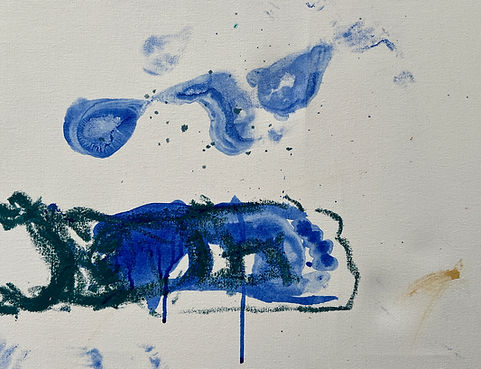
How does your painting process embody this idea of touch?
In my studio, I often paint without brushes—using my hands, fingertips, or even parts of my arm. I work with fluid materials that resist total control. The gestures, stains, and smears are not planned compositions; they’re traces of movement, emotion, and bodily memory. The process becomes a dialogue between my skin and the surface—a space where the body and the painting co-produce each other.
Painting is both critique and affirmation — a tactile encounter with the self.
Touch becomes a form of thinking.
Each mark is not an illustration of selfhood, but a becoming within it.
The resistance of paint materializes an encounter with internalized patriarchy.
Touching the Self: Embodiment, Power, and Affirmation in My MA Painting Practice
Introduction – Framing the Inquiry
My MA research began with a simple but urgent question: How can painting become an act of self-affirmation for a woman whose identity has been shaped by patriarchal and diasporic power? Over time, this inquiry became less about representing a fixed self and more about learning to touch the self — through paint, surface, gesture, and encounter. The studio became a space where touch could replace distance, and where material processes might undo the inherited hierarchies of seeing and knowing.
In this sense, my practice seeks to reclaim painting from its long association with the disembodied gaze. Western art history has often privileged vision — the distant, controlling eye that objectifies and categorizes. As a feminist painter, I turned instead to haptics: painting as the field of bodily negotiation, friction, and transformation. The MA project therefore unfolded through direct, physical contact with materials — pressing pigment with fingers, layering surfaces with gestures of both aggression and tenderness, and even staining the canvas through my own skin.
My MA show, installed on a yellow wall, marked the culmination of this process. The yellow surface, vibrant yet unstable, became a site of warmth and tension — a color that oscillates between comfort and agitation, visibility and exposure. By inviting the audience to engage tactilely — to hold and squeeze a small “nienien” object placed on their seats — I attempted to transform the exhibition from a one-way display into a reciprocal act of touch. The work thus extended beyond the canvas, into the ethical and relational field of contact between artist and viewer.
This critical reflection revisits that journey: how theory, bodily experience, and painting practice intertwined to generate knowledge that is at once personal and political. Drawing on feminist phenomenology and affirmative ethics (Irigaray, Braidotti, bell hooks), I examine how the act of painting — as resistance, repetition, and care — reshaped my understanding of subjectivity and power.
Context and Theoretical Framework
The project developed within a lineage of feminist and philosophical thought that questions how knowledge and selfhood are constructed. Simone de Beauvoir’s assertion that woman has been defined as the “Other” to man laid the foundation: in patriarchy, the female subject is rendered secondary, existing only in relation to male universality. Luce Irigaray further revealed that even the supposedly “neutral” concept of the human subject is masculine. This epistemic imbalance not only marginalizes women but also enforces a mode of seeing — a visual economy where woman is spectacle, never agent.
The studio thus became a place to resist that gaze. bell hooks describes the gaze as a site of both oppression and rebellion; to look back, or to refuse visibility altogether, is a political act. In my paintings, faces are often obscured or fragmented. Layers of thick paint veil the figure, refusing the viewer’s access. What remains visible is the trace of touch — the gesture itself, not the body on display. Through this deliberate concealment, I sought to reclaim control over representation, allowing opacity to become a mode of self-protection and agency.
Irigaray’s later text The Mediation of Touch profoundly informed this shift. She argues that knowledge must move away from objectifying distance toward an ethics of proximity — a tactile mode of knowing that acknowledges relation and difference without appropriation. Painting, for me, embodies this logic: to paint is to meet the world through contact rather than conquest. Each stroke is a negotiation, a small act of coexistence between pigment, surface, and skin.
Rosi Braidotti’s concept of “affirmative ethics” also shaped my approach. She proposes that feminist practice should not remain trapped in critique but move toward transformation — generating new forms of life and subjectivity. In my context, this meant that painting could not only expose patriarchal constraint but also enact self-renewal. The act of painting thus became both analytical and generative: I painted not to illustrate theory but to live through it, to test its possibilities in material time.
In this theoretical framework, painting becomes more than representation; it becomes a process of becoming. The brushstroke is a form of speech, but one that originates in the body, not the intellect. It is through such embodied articulation that a new subjectivity might emerge — one that acknowledges its scars and contradictions but remains capable of affirmation.
Studio Practice and Embodied Process
In the studio, theory encountered resistance — the weight of pigment, the uneven drag of paint, the instability of my own hand. Each session became a negotiation between control and surrender. I began to use my body not merely as tool but as participant: pressing my fingers, forearms, or even torso into the canvas, allowing the imprint to become evidence of contact. This was not a performance for the viewer but an intimate form of correspondence between skin and surface.
At times, I felt the paint push back. Thick layers refused to move; brushes stuck; color bled unpredictably. These small frictions mirrored the psychic resistance I encountered in confronting internalized patriarchal norms — the impulse to self-censor, to make the image “beautiful,” to seek approval. As Irigaray suggests, the tactile encounter holds ethical potential because it recognizes otherness without erasure. The paint’s resistance was thus not an obstacle but a teacher: it reminded me that dialogue requires boundaries, that self-affirmation includes learning to coexist with what resists.
In early works, such as Self-Portrait with Untitled (Fig. 1), I externalized emotional intensity through large, unrestrained gestures. The result was neither figurative nor abstract but affective — a record of bodily rhythm. Over time, I began to notice that certain gestures repeated across canvases: circular motions of rubbing, abrupt vertical streaks, or patches of erasure where pigment was scraped away. These became visual equivalents of emotional states — persistence, rupture, exhaustion. Through reflection, I realized they also echoed processes of memory and identity formation: layering, concealment, and resurfacing.

Fig. 1: Self-Portrait with Untitled, oil on canvas, 120 × 150 cm (2025). An early exploration of gesture as emotional release and confrontation.
Maintaining a reflective journal was crucial. After each painting session, I recorded sensations, thoughts, and theoretical resonances. For instance, a note from March reads: “The brush refuses — I insist — it becomes a fight, but in the struggle something honest appears.” Another entry observes: “When I use my hands directly, I stop thinking in words; the gesture speaks.” These writings revealed the degree to which embodied knowledge guided my process. As Barbara Bolt argues, practice generates its own epistemology — knowledge that arises from doing, rather than preceding it.
Through this documentation, I came to understand painting as both cognitive and somatic. Merleau-Ponty’s phenomenology supports this view: perception and meaning emerge from our bodily engagement with the world. When I paint, I do not stand outside the work; I am inside its temporal flow. The canvas becomes an extension of my body’s field, a membrane where interior and exterior meet. The action of mixing color or feeling the resistance of dried paint becomes a way of thinking. Knowledge materializes through movement.
At the same time, I confronted vulnerability. Working so physically brought moments of discomfort and exposure. There were days when the act of touching the canvas felt too intimate — as if I were uncovering private wounds. Yet these moments were essential: they marked the boundary between expression and revelation. The feminist artist Stephanie Spindler describes vulnerability as a radical method, enabling new embodied subjectivities to emerge. By staying within discomfort — allowing uncertainty rather than mastery — I could access a deeper honesty.


“Drawing is a focal format of my work… communicating vulnerability, perceptual flux, unresolved and imperfect ideas.”— Stephanie Spindler, Artist Statement.
Color also became a language of embodiment. Red, bule, and yellow tones recurred — colors associated with skin, warmth, and emotional immediacy. But rather than using them symbolically, I treated them as temperatures, sensations. The mixture of oil and pigment on my fingertips blurred distinctions between body and material. In this sense, painting was not a depiction of touch but touch itself — a haptic dialogue that transformed both surface and self.

Fig. 2: Process detail – layered surface, oil and acrylic on canvas (2025).Traces of touch reveal the intersection of control, resistance, and surrender.
The MA Show – Spatial and Dialogic Encounter
The MA Show offered an opportunity to extend these studio discoveries into a public space. The decision to paint the wall yellow emerged intuitively, then crystallized as a conceptual statement. Yellow carries contradictory associations: sunlight and illness, optimism and warning. On the gallery wall, it created a charged environment — a background that refused neutrality. Against it, the paintings appeared both radiant and uneasy, echoing my desire to hold tension rather than resolve it.

Fig. 3: MA Show installation view (yellow wall), 2025. The yellow environment transformed the viewing experience into a field of affect.
The exhibition layout emphasized proximity. Paintings were hung at slightly lower height, inviting viewers to come close. This spatial choice resisted the elevated, “untouchable” aura of modernist painting. Instead, it encouraged intimacy — a feeling of being within the painter’s bodily field. Some visitors described a sense of warmth; others felt unsettled. Both responses affirmed the relational quality I sought: painting not as spectacle but as encounter.
To extend this relational logic, I placed a small object — the “nienien” squeeze toy — on each chair. Soft, skin-like, and slightly absurd, it invited the audience to engage their own sense of touch while listening or viewing. This gesture stemmed from my interest in subject-to-subject communication. I wanted to destabilize the hierarchy between speaker and listener, artist and viewer. By holding the same tactile object I had used in the studio for stress and grounding, the audience shared a fragment of my sensory world. The simple act of squeezing became a parallel to painting: a negotiation between pressure and release.

Fig. 4: Audience interaction with “nienien” object, latex and TPR, 2025. A participatory element that extends touch from the studio to the collective space.
bell hooks’ writing on community and love as political forces resonates here. She reminds us that healing from patriarchal structures requires relational engagement — the capacity to feel with others rather than against them. The installation sought to embody this ethos: not a didactic critique but a field of affective exchange. The tactile invitation blurred the boundaries between private and public, self and other. Some visitors instinctively pocketed the “nienien,” carrying it home like a secret companion — an unplanned but meaningful form of participation that transformed the artwork’s afterlife.
In reflecting on the exhibition, I realized that my role as artist had shifted. I was no longer offering images for interpretation but constructing situations of touch, where knowledge could circulate through bodies rather than words. This redefined authorship as relational: a dialogue that unfolds in proximity, not from above. The yellow wall, the texture of paint, the small objects — all became mediators in this conversation. Together, they enacted what Irigaray might call an “ethics of two,” a coexistence without domination.
Reflection and Future Directions
Looking back, my MA journey unfolded as both artistic and philosophical transformation. When I began, I was preoccupied with critique — how to expose the patriarchal gaze, how to represent the diasporic self. Through painting, I discovered a different kind of knowledge: not purely intellectual, but tactile, rhythmic, and relational. The studio taught me that self-affirmation is not a declaration of independence but an ongoing negotiation of relation. To affirm the self is to stay in contact — with materials, with memory, with others — without dissolving into them.
This realization aligns with Rosi Braidotti’s call for an affirmative politics of becoming. Rather than positioning myself solely as victim or rebel, I began to see my practice as generative — producing new forms of life and subjectivity. Each painting, each layer of touch, became a small experiment in living differently. The act of painting thus moved beyond self-expression toward self-construction: a continuous remaking of who I am through material encounter.

Fig. 5: A quick sketch depicting inner struggles and changes.
The reflective process also altered my understanding of power. Foucault describes power not only as repression but as productive — it shapes and produces subjectivity. In this light, painting became a way to visualize and transform those forces. The resistance of paint, the rhythm of repetition, and the vulnerability of exposure all mirrored the operations of power on the body. But through engagement, they also generated agency. Power was no longer something external to overcome, but something internal to be re-channeled.


Fig. 6–7 :These mind maps, developed in Unit 2, trace my process of understanding how my self-perception of the body has been shaped. They begin with the influence of social and media representations of the female body, and extend to the broader social structures that discipline and regulate women’s bodily appearance. From there, they move toward the question of where power operates—who exerts power over whom, and how such power becomes internalized to the point that I once perceived it as “natural.”
As Foucault states, “On the other hand, if I use my age, my social position, the knowledge I may have about this or that, to make you behave in some particular way—that is to say, I’m not forcing you at all and I’m leaving you completely free—that’s when I begin to exercise power.” (Michel Foucault, “Power, Moral Values, and the Intellectual,” 1980.)
If the MA project offered a glimpse of transformation, the next step is to deepen it through research. My forthcoming PhD proposal — Painting as Affirmation: Deconstructing Self and Patriarchy through Practice-Led Painting Research — extends this inquiry into a systematic exploration of how painting can function as feminist epistemology. The MA experience provided both the conceptual foundation and the embodied evidence for that trajectory. It demonstrated that painting, when understood as a form of touch, can produce knowledge about gendered subjectivity that no amount of textual analysis could capture.
Ultimately, this project has taught me that painting is not a retreat from theory but a form of theory itself — one articulated through gesture, color, and resistance. It is a way of thinking with the body, of transforming silence into texture. As Audre Lorde reminds us, “poetry is not a luxury”; it is a vital tool of survival and change. Painting, in my case, occupies that same necessity. It allows me to translate pain into material, to re-inhabit my own skin, to become visible to myself.

Fig. 8: Detail – layered impasto surface, oil on canvas (2025).Painting as tactile thinking: the materialization of self-encounter.
Conclusion
To paint is to touch thought. Through this MA project, I have come to understand that every mark carries both a gesture of resistance and a gesture of care. The body remembers its histories — of discipline, migration, gendered expectation — and releases them through movement. Each layer of pigment becomes a record of negotiation between what has been imposed and what is emerging. The yellow wall, the squeeze toy, the unfinished surfaces — all these are not symbols but traces of an ongoing process: the effort to exist otherwise.
In the end, the most significant discovery of my MA research was not a single painting or theory, but a mode of attention — a way of listening through the skin. This attentiveness transforms painting into an ethics: a practice of staying in relation, of touching without possession. Through it, I found that affirmation does not mean shouting one’s identity into visibility, but quietly insisting on presence through contact.


Figs. 9–10: Studio diary-style drawing records that trace my intuitive processes in the studio. These drawings capture shifts in gesture, mood, and bodily awareness, functioning as a visual record of thinking-through-making.
As I move forward, I will continue to explore how painting can function as a haptic philosophy — a living method that bridges thought and touch, critique and compassion. What remains constant is the commitment to transformation: to keep painting as a form of becoming, a dialogue between self and world that resists closure. For me, this is the most profound kind of knowledge art can offer.
Reference:
Aumann, Antony. Kierkegaard, Aesthetics, and Selfhood: The Art of Subjectivity. Routledge, 2019.
Barrett, Estelle, and Barbara Bolt, editors. Practice as Research: Approaches to Creative Arts Enquiry. I.B. Tauris, 2007.
Beauvoir, Simone de. The Second Sex. Translated by Constance Borde and Sheila Malovany-Chevallier, Vintage, 2011.
Bolt, Barbara. Art Beyond Representation: The Performative Power of the Image. I.B. Tauris, 2004.
Cha, Theresa Hak Kyung. Dictee. Tanam Press, 1982.
Griffiths, Morwenna. Feminisms and the Self: The Web of Identity. Routledge, 1995.
Hall, Stuart. “Cultural Identity and Diaspora.” Identity: Community, Culture, Difference, edited by Jonathan Rutherford, Lawrence & Wishart, 1990.
Hetherington, Sarah. “Painting as Amy Sillman.” Women’s Studies, vol. 41, no. 8, 2012, pp. 976–992.
hooks, bell. Black Looks: Race and Representation. South End Press, 1992.
Irigaray, Luce. The Mediation of Touch. Bloomsbury Academic, 2024.
—. This Sex Which Is Not One. Translated by Catherine Porter and Carolyn Burke, Cornell UP, 1985.
Kaneda, Shirley. “The Feminine in Abstract Painting Reconsidered.” Women & Performance: A Journal of Feminist Theory, vol. 27, no. 3, 2017, pp. 339–345.
Lorde, Audre. Sister Outsider: Essays and Speeches. Crossing Press, 2007.
Merleau-Ponty, Maurice. Phenomenology of Perception. Translated by Colin Smith, Routledge, 1962.
Mitcheson, Katrina. “Knowing Ourselves through Art: Aesthetic Experience and Self-Knowledge.” Philosophical Papers, vol. 50, no. 1, 2021, pp. 1–24.
Nochlin, Linda. “Why Have There Been No Great Women Artists?” ArtNews, Jan. 1971, pp. 22–39.
Sartre, Jean-Paul. Being and Nothingness. Translated by Hazel E. Barnes, Routledge, 2003.
Schor, Mira. Wet: On Painting, Feminism, and Art Culture. Duke UP, 1997.
Sharma, Sita. Reframing Migration: Feminist Autoethnography and Visual Storytelling in Nepal. University of London Press, 2022.
Sillman, Amy. Back of a Horse Costume x 2. 2015–16. Oil and acrylic on canvas, 190.5 × 167.6 cm. (Work cited via gallery listing and reviews.)
Spindler, Stephanie. “Artist Statement.” Stephanie Spindler Studio. Accessed 2 Nov. 2025.
—. The Vulnerable Subject: Feminist Phenomenology and Installation Practice. PhD dissertation, University of Dundee, 2020.